

The Stoics faced exile, slavery, plague and war. Marcus Aurelius ruled Rome through all of it, and Epictetus was born a slave. Their words still shape strong minds today.
This list gives you 45 Stoic Quotes That Forged Unbreakable Minds with plain meanings. Pick one line and use it for a week. Quotes come from public-domain translations by George Long, Elizabeth Carter and Richard Gummere. I lightly modernized the spelling and capitalization.
Table of Contents
Stoic Quotes on Discipline That Forged Unbreakable Minds
Building an unbreakable mind is not just about developing discipline and emotional strength; it also means learning how to handle moments of isolation and emotional disconnection. When loneliness becomes difficult to manage, exploring Stoic wisdom for overcoming loneliness can offer a fresh perspective on finding inner peace, accepting solitude, and strengthening your relationship with yourself. Stoic Quotes That Forged Unbreakable Minds.
Stoic discipline means choosing a thought-out action over an impulse. These 15 lines show how to build it.
“In the morning when thou risest unwillingly, let this thought be present: I am rising to the work of a human being.”
Marcus Aurelius, Meditations 5.1
Even an emperor had to argue himself out of bed. Reluctance is normal. Purpose beats it.
“Our plans miscarry because they have no aim. When a man does not know what harbour he is making for, no wind is the right wind.”
Seneca, Letters 71.3
Without a clear goal, every task feels urgent. Write one aim each morning.
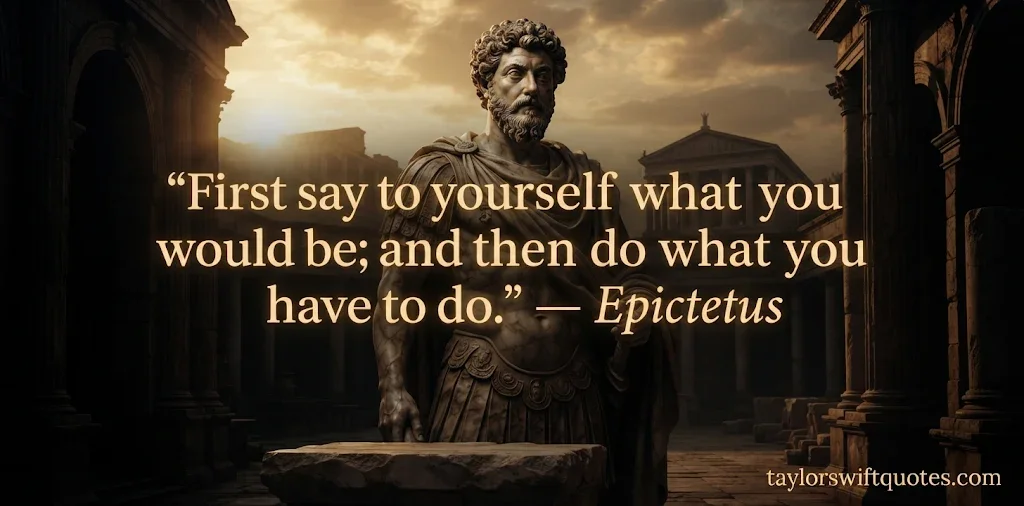
“First say to yourself what you would be; and then do what you have to do.”
Epictetus, Discourses 3.23
Decide who you want to be. Your actions will follow that choice.
“Every habit and faculty is confirmed and strengthened by the corresponding actions, that of walking by walking, that of running by running.”
Epictetus, Discourses 2.18
Habits grow through repetition. Small daily reps beat rare bursts of effort.
“No longer talk at all about the kind of man that a good man ought to be, but be such.”
Marcus Aurelius, Meditations 10.16
Knowing is not enough. Act on what you believe.
“Never call yourself a philosopher, nor talk a great deal among the unlearned about theorems; but act conformably to them.”
Epictetus, Enchiridion 46
Don’t announce your goals. Do the first rep instead.
Musonius Rufus, who taught Epictetus, said virtue needs practice, not only theory. A doctor or a musician must train, and so must you. See his lectures on training.
“Everywhere means nowhere.”
Seneca, Letters 2.2
Jumping between tasks leaves nothing finished. Stay with one thing.
“The spirit ought to be brought up for examination daily.”
Seneca, On Anger 3.36
End each day with a quick self-review. Ask what went well and what to fix.
“It is not that we have a short time to live, but that we waste much of it.”
Seneca, On the Shortness of Life 1
Time is the one resource you can’t earn back. Guard it.
“If it is not right do not do it; if it is not true do not say it.”
Marcus Aurelius, Meditations 12.17
Use this as a filter before you act or speak.
“This is the perfection of moral character: to pass every day as the last.”
Marcus Aurelius, Meditations 7.69
Live each day with full attention. This is the Stoic habit of memento mori.
“Philosophy teaches us to act, not to speak.”
Seneca, Letters 20
Wisdom shows up in behavior, not in talk.
“Immediately prescribe some character and form of conduct to yourself, which you may preserve both alone and in company.”
Epictetus, Enchiridion 33
Set clear personal rules. Keep them whether anyone is watching or not.
“Set aside a certain number of days, during which you shall be content with the scantiest and cheapest fare.”
Seneca, Letters 18.5
This is voluntary discomfort. Practice a little hardship so real hardship feels less scary.
“Hold every hour in your grasp.”
Seneca, Letters 1
Treat each hour as yours to use well.
Powerful Stoic Quotes on Strength and Resilience

These powerful Stoic quotes train resilience. They turn setbacks into practice.
“That which is a hindrance is made a furtherance to an act; and that which is an obstacle on the road helps us on this road.”
Marcus Aurelius, Meditations 5.20
This is the root of “the obstacle is the way.” Use the problem as your material.
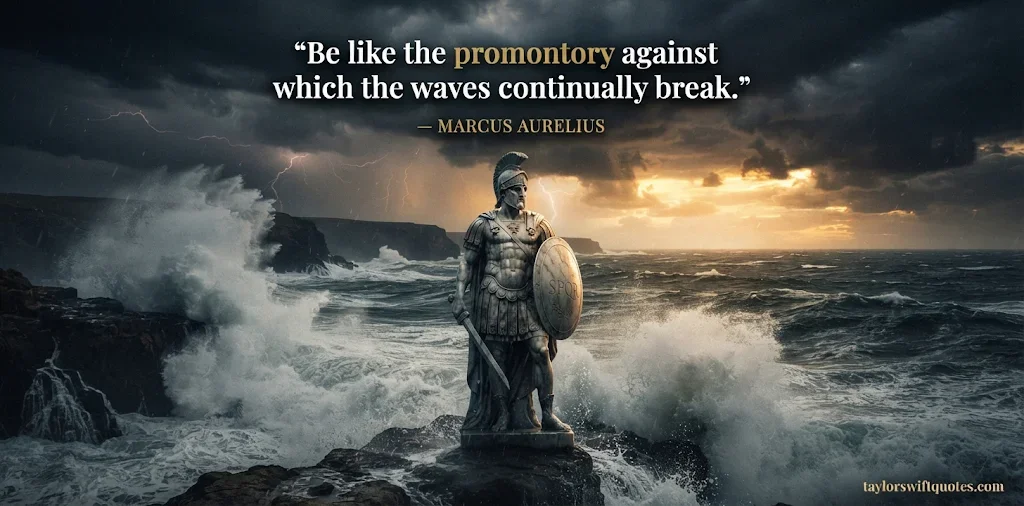
“Be like the promontory against which the waves continually break; but it stands firm and tames the fury of the water around it.”
Marcus Aurelius, Meditations 4.49
Stay steady while pressure hits you. Calm is a form of strength.
“Fire tests gold, misfortune brave men.”
Seneca, On Providence 5
Hard times reveal your character. They also build it.
“We suffer more often in imagination than in reality.”
Seneca, Letters 13
Fear grows in your head first. Ask what is actually happening.
“Men are disturbed, not by things, but by the principles and notions which they form concerning things.”
Epictetus, Enchiridion 5
Your judgment of an event causes most of the pain. Change the judgment.
“If thou art pained by any external thing, it is not this thing that disturbs thee, but thy own judgment about it. And it is in thy power to wipe out this judgment now.”
Marcus Aurelius, Meditations 8.47
You can’t control events. You can control how you read them.
“Take away thy opinion, and then there is taken away the complaint, ‘I have been harmed.’”
Marcus Aurelius, Meditations 4.7
Feeling harmed often starts with a story you tell yourself.
“Some things are in our power, and others not.”
Epictetus, Enchiridion 1
This is the dichotomy of control, the base of Stoicism. Sort every worry into one of those two groups.
“Require not things to happen as you wish; but wish them to happen as they do happen; and you will go on well.”
Epictetus, Enchiridion 8
Stop arguing with what already happened. Ask what you can do next.
“You may be unconquerable, if you enter into no combat in which it is not in your own power to conquer.”
Epictetus, Enchiridion 19
Pick battles you can win. Seeking everyone’s approval is not one of them.
“Sometimes even to live is an act of courage.”
Seneca, Letters 77
Courage is not always loud. Sometimes it is simply carrying on.
“The Fates lead the willing, and drag the unwilling.”
Seneca, Letters 107
Accept what you can’t change. Resistance only adds pain.
“Conduct me, Jove, and Thou, O Destiny, wherever your decrees have fixed my station. I follow cheerfully.”
Cleanthes, quoted in Epictetus, Enchiridion 53
This is early amor fati, the love of one’s fate.
“Remember that you are an actor in a drama, of such a kind as the author pleases to make it.”
Epictetus, Enchiridion 17
You don’t pick your role. You choose how well you play it.
“If you shape your life according to nature, you will never be poor; if according to opinion, you will never be rich.”
Seneca, Letters 16
Real needs are few. Wants have no limit.
Famous Stoic Quotes on Self-Control and Mastery

Self-control is the heart of self-mastery. These famous Stoic quotes cover anger, speech, thought and time.
“The greatest remedy for anger is delay.”
Seneca, On Anger 2.29
Wait two minutes before you reply. The angry draft often shrinks or disappears.
“The best way of avenging thyself is not to become like the wrong doer.”
Marcus Aurelius, Meditations 6.6
Don’t let someone else’s behavior lower yours.
“Is a little oil spilt? A little wine stolen? Say to yourself, ‘This is the price paid for tranquillity.’”
Epictetus, Enchiridion 12 (paraphrased)
Start with small annoyances. That is where you gain the reps.
“Such as are thy habitual thoughts, such also will be the character of thy mind; for the soul is dyed by the thoughts.”
Marcus Aurelius, Meditations 5.16
Your repeated thoughts shape your mindset. Feed your mind with care.
“Begin the morning by saying to thyself, I shall meet with the busybody, the ungrateful, arrogant, deceitful, envious, unsocial.”
Marcus Aurelius, Meditations 2.1
This is premeditation. Expect friction, and it won’t throw you off.
“The reason why we have two ears and only one mouth is that we may hear more and talk less.”
Zeno of Citium, via Diogenes Laërtius 7.23
Zeno founded Stoicism around 300 BC. Listening is a discipline too.
“Better to trip with the feet than with the tongue.”
Zeno of Citium, via Diogenes Laërtius 7.26
Words can’t be taken back. Pause before you speak.
“Remember, that not he who gives ill language or a blow affronts, but the principle which represents these things as affronting.”
Epictetus, Enchiridion 20
An insult only lands if you accept it.
Aulus Gellius reports that Musonius Rufus made this point. Effort passes but the good stays, while pleasure passes but the shame stays. Hard work pays off, and shortcuts cost you later.
“It is impossible for a man to learn what he thinks he already knows.”
Epictetus, Discourses 2.17
Humility keeps you improving. Stay a student.
“It is in thy power whenever thou shalt choose to retire into thyself.”
Marcus Aurelius, Meditations 4.3
Calm is available at any time. It doesn’t depend on a quiet place.
“If thou workest at that which is before thee, following right reason seriously, vigorously, calmly.”
Marcus Aurelius, Meditations 3.12
Do the task in front of you. Skip the drama.
“Do not act as if thou wert going to live ten thousand years. Death hangs over thee. While thou livest, while it is in thy power, be good.”
Marcus Aurelius, Meditations 4.17
Limited time sharpens your choices.
Seneca also reports that wise people have called anger a brief madness (On Anger 1.1). Anger clouds judgment, so slow down.
“Nothing, Lucilius, is ours, except time.”
Seneca, Letters 1
Spend it on what matters. This line ends the list on purpose.
How to Use Stoic Quotes Daily to Build a Strong Mind
Quotes only work when you use them. Here is a simple plan.
Morning: Read one quote aloud. Write one aim for the day before you check your phone.
During the day: Catch the gap between urge and action. Ask, “What is in my power right now?”
Evening: Do Seneca’s review. What did I do well? Where did I fall short? What will I change tomorrow?
Weekly: Pick one small discomfort. Walk instead of driving, or skip a treat. Keep it safe and simple.
Real people have used this. James Stockdale, a US Navy pilot, was a prisoner of war in Vietnam for about seven and a half years. He credited Epictetus for helping him endure. Stoic ideas also shaped modern therapy. Albert Ellis drew on Epictetus when he built rational emotive behavior therapy.
FAQs
What did the Stoics say about discipline?
They treated discipline as training your power of choice. Marcus Aurelius stressed duty and purpose. Epictetus focused on the moment of impulse. Seneca urged clear aims, delay before anger and daily review. Musonius Rufus said virtue needs practice.
What is a famous quote about discipline?
Marcus Aurelius’s Meditations 5.1 is a strong pick: “I am rising to the work of a human being.” Many people also cite “We are what we repeatedly do.” Aristotle never wrote it. Will Durant summed up Aristotle’s ideas that way in 1926.
What is a powerful Stoic quote?
Many readers choose Marcus Aurelius’s obstacle line (Meditations 5.20). Epictetus’s Enchiridion 5 is just as strong: our judgments disturb us more than events do. Both put control back in your hands.
What did Plato say about discipline?
Plato was not a Stoic, but he shaped Greek thought before them. In the Laws, he called self-conquest the first and best victory. He also saw a healthy soul as one where reason guides desire. The Stoics later built on that idea.
Conclusion
These Stoic quotes have lasted about 2,000 years. They work because they are simple and practical. Choose one line today, act on it, and check your progress tonight.

Jimmy Faisal is a passionate writer and quote enthusiast at Quotes Blooms. He enjoys exploring the power of words and sharing meaningful quotes, inspiring thoughts, and heartfelt messages that connect with people from all walks of life.