Stoic quotes on learning do more than sound smart. They show you how to study, stay humble, and turn ideas into habits.
This guide shares 50+ powerful Stoic quotes on learning and lifelong wisdom from Marcus Aurelius, Seneca, Epictetus, and others. Each quote comes with a plain meaning you can use today.
Table of Contents
Why Stoic Quotes on Learning Still Matter Today

Stoicism began in Athens around 300 BC with Zeno of Citium, as the Stanford Encyclopedia of Philosophy explains. Its core goal was to live wisely and well, and learning was a daily duty, not a school phase.
Learning and lifelong wisdom teach us to value knowledge, make better choices, and use our time with purpose. But one of the most powerful Stoic lessons is that our time is limited, which is why understanding the Stoic philosophy of death and living each moment intentionally can completely change how you approach life.
Many Stoics lived the lesson. Epictetus was born enslaved and later taught philosophy in freedom. Marcus Aurelius wrote Meditations as private notes to himself, not for fame. Seneca wrote 124 letters to his friend Lucilius about how to live.
The same urge to grow is alive in America today. Pew Research Center found that 73% of U.S. adults say the phrase “lifelong learner” describes them very well. Of those who pursued personal learning, 87% said it made them feel more capable and well rounded (Pew, 2016).
Yet reading is uneven. In a 2025 Pew survey, 75% of adults had read at least part of a book in the past year, but 38% read only one to five. Among college graduates, 88% had read one. (Pew, 2026).
The Stoics would say that reading more is not the point. Using what you learn is. Translations vary, so you may see slightly different wording elsewhere.
Stoic Quotes on Learning and Education
These Stoic quotes on education show how ancient thinkers studied, practiced, and stayed humble. Each one has a short meaning.
“Waste no more time arguing what a good man should be. Be one.” — Marcus Aurelius, Meditations 10.16
Stop debating. Start doing.
“If any man can show me that I think or act wrongly, I will gladly change; for I seek the truth, which never harmed anyone.” — Marcus Aurelius, Meditations 6.21
A good learner welcomes correction.
“The soul becomes dyed with the color of its thoughts.” — Marcus Aurelius, Meditations 5.16
What you read and think shapes your mind.
“Look within. Within is the fountain of good.” — Marcus Aurelius, Meditations 7.59
Real learning includes honest self-checks.
“If it is not right, do not do it; if it is not true, do not say it.” — Marcus Aurelius, Meditations 12.17
Check facts and motives before you act.
“As long as you live, keep learning how to live.” — Seneca, Letters 76
Education has no finish line.
“It is not important how many books you have, but how good they are.” — Seneca, Letters 2
Quality beats quantity.
“Everywhere means nowhere.” — Seneca, Letters 2
Jumping between too many sources scatters your mind.
“It is one thing to remember, another to know.” — Seneca, Letters 33
Memory repeats. Knowledge makes an idea your own.
“Men learn while they teach.” — Seneca, Letters 7
Explaining an idea to someone else deepens your grasp of it.
“Associate with people who are likely to improve you.” — Seneca, Letters 7
Your circle shapes your growth.
“No man is good by chance. Virtue must be learned.” — Seneca, Letters 90
Character is a skill you can train.
“We learn for the classroom, not for life.” — Seneca, Letters 106 (his complaint about schooling)
Learn what you can use outside the classroom.
“Only the educated are free.” — Epictetus, Discourses 2.1
Knowledge frees the mind, even when life is hard.
“It is impossible for a man to begin to learn what he thinks he already knows.” — Epictetus, Discourses 2.17
Pride blocks progress. Stay curious.
“If you wish to be a writer, write.” — Epictetus, Discourses 2.18
Skill grows through action.
“First say to yourself what you would be; and then do what you have to do.” — Epictetus, Discourses 3.23
Pick a goal, then do the work.
“Philosophers warn us not to be content with mere learning, but to add practice and then training.” — Epictetus, Discourses 2.9
Without practice, we forget and slip back into old habits.
“If you want to improve, be content to be thought foolish and stupid.” — Epictetus, Enchiridion 13
Looking clueless at first is part of learning.
“What is the first business of one who practices philosophy? To get rid of self-conceit.” — Epictetus, Discourses 2.17
Drop the ego first.
“The beginning of philosophy is the recognition of the conflict between opinions.” — Epictetus, Discourses 2.11
Wisdom starts when you notice that people disagree and ask why.
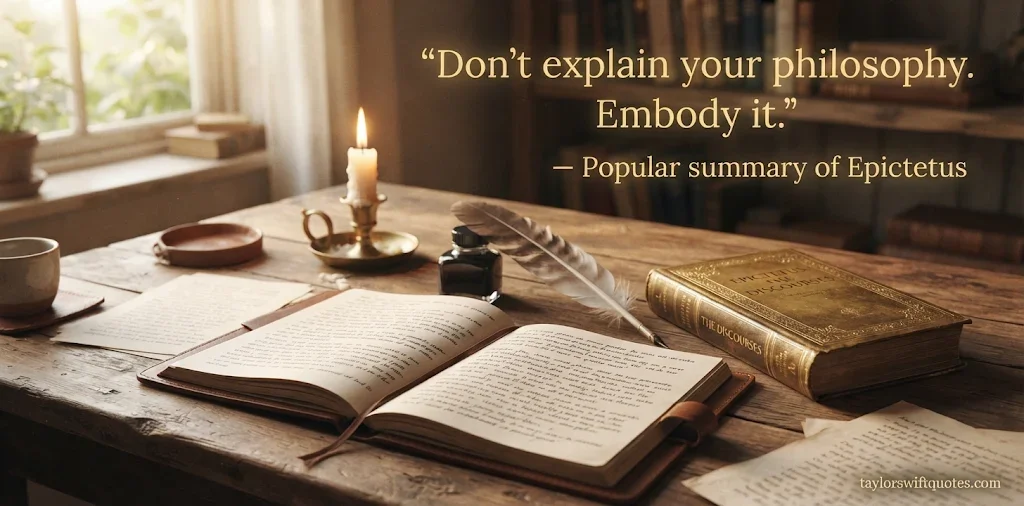
“Don’t explain your philosophy. Embody it.” — popular summary of Epictetus, Enchiridion 46
Your actions teach louder than your words.
“Just as there is no use in medical study unless it leads to health, so no teaching is useful unless it leads to virtue.” — Musonius Rufus (adapted)
Study should change how you live.
“We have two ears and one mouth so that we may listen more and talk less.” — Zeno of Citium, reported by Diogenes Laërtius
Listening is a learning tool.
“Well-being is realized by small steps, but is truly no small thing.” — Zeno of Citium (attributed)
Small daily habits add up.
“What man actually needs is not a tensionless state but the striving and struggling for some goal worthy of him.” — Viktor Frankl, Man’s Search for Meaning
Frankl was not a Stoic, but his view fits. Growth needs a worthy challenge.
“The unexamined life is not worth living.” — Socrates, in Plato’s Apology 38a
Socrates shaped Stoic thought. Ask questions about your own life.
Stoic Quotes on Lifelong Wisdom and Personal Growth

Stoic wisdom quotes help you stay calm, focused, and strong as life changes. Here they are by theme.
“Very little is needed to make a happy life; it is all within yourself, in your way of thinking.” — Marcus Aurelius, Meditations 7.67
Peace starts with your own thoughts.
“Confine yourself to the present.” — Marcus Aurelius, Meditations 7.29
Focus on today’s task.
“Never let the future disturb you. You will meet it with the same weapons of reason that arm you against the present.” — Marcus Aurelius, Meditations 7.8
Worry adds nothing. Clear thinking does.
“We suffer more often in imagination than in reality.” — Seneca, Letters 13
Most fears never happen.
“Men are disturbed not by things, but by the views they take of them.” — Epictetus, Enchiridion 5
Your judgment of an event matters more than the event.
“Don’t seek for everything to happen as you wish, but wish for everything to happen as it does.” — Epictetus, Enchiridion 8
Accept reality, then act well inside it.
“Accept the things to which fate binds you.” — Marcus Aurelius, Meditations 6.39
Work with what you cannot change.
“The impediment to action advances action. What stands in the way becomes the way.” — Marcus Aurelius, Meditations 5.20
Obstacles can become your teacher.
“Take away your opinion, and the complaint ‘I have been harmed’ is gone.” — Marcus Aurelius, Meditations 4.7
Reframing hurt can ease it.
“If you are pained by any external thing, it is not this thing that disturbs you, but your own judgment about it.” — Marcus Aurelius, Meditations 8.47
You can change a judgment right now.
“I judge you unfortunate because you have never lived through misfortune.” — Seneca, On Providence 3.3
Hardship shows you what you can do.
“It is a rough road that leads to the heights of greatness.” — Seneca, Letters 78
Growth rarely feels easy.
“Sometimes even to live is an act of courage.” — Seneca, Letters 78
Some days, carrying on is the win.
“When we are no longer able to change a situation, we are challenged to change ourselves.” — Viktor Frankl, Man’s Search for Meaning
When the world won’t move, you can.
“The best revenge is not to be like your enemy.” — Marcus Aurelius, Meditations 6.6
Protect your character.
“A vulgar man blames others; a beginner in philosophy blames himself; a philosopher blames neither.” — Epictetus, Enchiridion 5
Wisdom drops blame and looks for the lesson.
“It is not that we have a short time to live, but that we waste a lot of it.” — Seneca, On the Shortness of Life 1.3
Time is enough if you guard it.
“While we are postponing, life speeds by.” — Seneca, Letters 1
Delay costs more than effort.
“If a man knows not to which port he sails, no wind is favorable.” — Seneca, Letters 71
Set a clear goal before you chase tips and tricks.
“Life is very short and anxious for those who forget the past, neglect the present, and fear the future.” — Seneca, On the Shortness of Life 15.4
Learn from yesterday. Live today. Don’t dread tomorrow.
“Do not act as if you had ten thousand years to live.” — Marcus Aurelius, Meditations 4.17
Use the memento mori idea as a push to start.
“You may depart from life this very moment. Regulate your acts and thoughts accordingly.” — Marcus Aurelius, Meditations 2.11
Let your limited time guide your choices.
“Wealth consists not in having great possessions, but in having few wants.” — Epictetus (fragment)
Fewer wants means more freedom.
“No man is free who is not master of himself.” — Epictetus (attributed)
Self-mastery comes before every other freedom.
“How long will you wait before you demand the best of yourself?” — Epictetus, Enchiridion 51
Start now.
“Nothing is a better proof of a well-ordered mind than a man’s ability to stop just where he is and spend some time in his own company.” — Seneca, Letters 2
Quiet time is a sign of strength.
How to Apply Stoic Wisdom to Learning Every Day
Quotes only work when you use them. Try this simple routine for lifelong learning.
- Set a morning aim. Write one thing you want to learn or practice. The Stoics called steady attention prosoche.
- Read less, but deeper. Follow Seneca’s advice. Pick a few good books and reread them.
- Write one note. Put one idea in your own words. This turns reading into thinking.
- Test it once. Use that idea in a real task before bed. Epictetus asked for practice, not talk.
- Review your day. Seneca described a nightly review of his actions. Ask what went well, what went wrong, and what to fix.
Start with Meditations, Seneca’s Letters from a Stoic, and Epictetus’s Enchiridion. All three are short, practical reads.
Avoid three common mistakes. Do not hoard quotes without acting on them. Do not read passively. Do not use Stoicism to hide feelings. It is meant to help you understand them.
FAQs
What is the most famous Stoic quote?
No single quote holds the official title. One of the most cited is Marcus Aurelius’s line: “The impediment to action advances action. What stands in the way becomes the way.” A popular 2014 book borrowed it as its title. Epictetus’s “Men are disturbed not by things, but by the views they take of them” is also widely shared.
What are 7 famous quotes from Marcus Aurelius?
- “Waste no more time arguing what a good man should be. Be one.”
- “The impediment to action advances action.”
- “The soul becomes dyed with the color of its thoughts.”
- “Confine yourself to the present.”
- “The best revenge is not to be like your enemy.”
- “Very little is needed to make a happy life.”
- “Accept the things to which fate binds you.”
What did Socrates say about education?
Socrates lived before Stoicism but shaped it. In Plato’s Apology, he said the unexamined life is not worth living. He also claimed to be wise only because he knew what he did not know. In Plato’s Theaetetus, he compared his teaching to midwifery: he helped others bring out their own ideas. A popular line about education as lighting a fire is often credited to him, but it echoes the Greek writer Plutarch, not Socrates.
What is a famous quote about learning?
Seneca’s “As long as you live, keep learning how to live” is among the best known. It says learning never ends. It also ties study to how we live, not just what we know.
Conclusion
The best Stoic quotes on learning and lifelong wisdom share one message: learn, then act. Pick one quote from this list today. Use it once, and note what changes.

Jimmy Faisal is a passionate writer and quote enthusiast at Quotes Blooms. He enjoys exploring the power of words and sharing meaningful quotes, inspiring thoughts, and heartfelt messages that connect with people from all walks of life.