

You replay the same awkward conversation at 2 a.m. Then you rehearse a disaster that has not happened. It is tiring, and it feels impossible to switch off.
The good news: Stoic quotes to stop overthinking have helped anxious minds for nearly 2,000 years. Marcus Aurelius, Seneca and Epictetus all wrote about this exact problem.
Below are 7 Stoic quotes that calm a racing mind. Each one has a plain meaning and a 60-second action. One honest note first: no single line works “forever.” Calm lasts when you practice it.
Table of Contents
Why You Overthink and How Stoicism Helps You Stop

Overthinking is a mental loop, not a character flaw. Stoicism treats it as a habit of judgment, and habits can change.
Overthinking often makes stressful situations feel bigger than they really are, but Stoic philosophy teaches us how to separate what we can control from what we cannot. Exploring these Stoic quotes for handling stress and life’s challenges can help you develop a calmer mindset, face reality with greater clarity, and respond to everyday difficulties with wisdom.
Psychologists call this loop rumination. It means repeating negative thoughts about the past or the future. Research reviews show that rumination can worsen mood and feed depression.
The problem is common. The National Institute of Mental Health reports that 19.1% of US adults had an anxiety disorder in the past year. About 31.1% will have one at some point in life. Overthinking is not a diagnosis. But the two often travel together.
Stoicism began around 300 BC in Athens. Zeno of Citium taught under a painted porch called the Stoa, which gave the school its name.
Epictetus gave the core diagnosis in his Enchiridion. We are upset by our judgments about events, not by the events themselves. Then he added a tool, the dichotomy of control. Some things are up to you: your opinions, choices and actions. Others are not: other people’s reactions, the economy, the outcome.
Modern therapy borrowed this idea. Albert Ellis and Aaron Beck founded rational emotive behavior therapy and cognitive behavioral therapy (CBT). Both named Stoicism as a philosophical forerunner. Still, Stoicism is a philosophy, not a treatment.
Early evidence is encouraging. Stoic Week is a free course that began at the University of Exeter. From 2014 to 2018, finishers reported 14% to 16% fewer negative emotions. These results are self-reported and have no control group. Fewer than a third of starters finished. Treat them as a promising sign, not proof.
How to read the quotes below: read it, reframe the thought, then act.
7 Stoic Quotes to Stop Overthinking Instantly
These stoic quotes about overthinking work best with one small action each. Pick the one that matches your worry today.
Seneca: “We suffer more often in imagination than in reality.”
Meaning: This line comes from Letter 13 of his Letters to Lucilius, titled “On Groundless Fears.” Your mind charges you for a disaster long before it arrives. Often it never does.
Use it when: you catastrophize before a job interview, a doctor’s call or a layoff rumor.
Try this: Write three lines. The worst case. The most likely case. Your next small step.
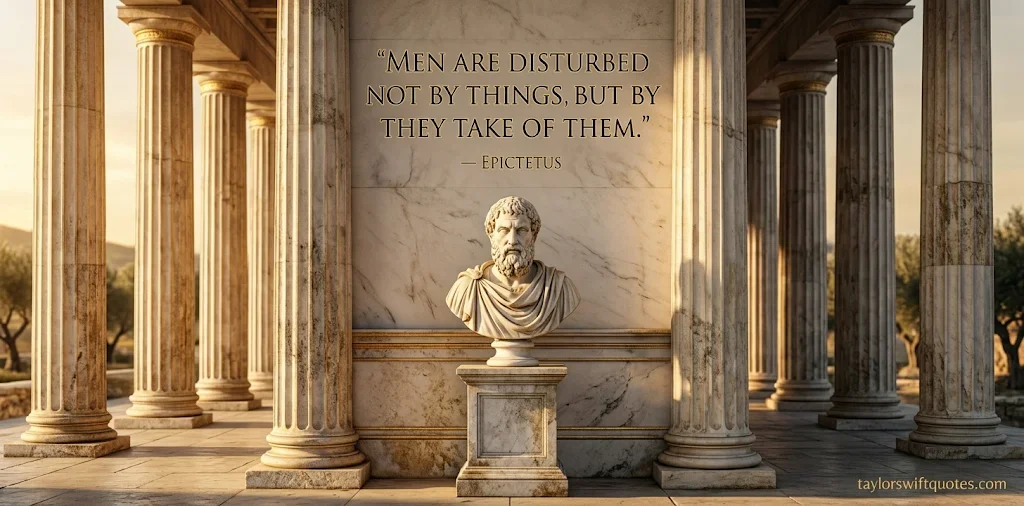
Epictetus: “Men are disturbed not by things, but by the views they take of them.”
Meaning: An event happens. Then your mind adds a story. A text left on read is the event. “They’re mad at me” is the story. Albert Ellis taught this line to many of his clients.
Use it when: you read too much into tone, silence or emojis.
Try this: Write one fact and one story. Cross out the story.
Marcus Aurelius: “…the pain is not due to the thing itself.”
Meaning: In Meditations 8.47, he adds that the pain comes from your estimate of the thing, and you can revoke that estimate at any moment. Psychiatrist Viktor Frankl made a similar point. When you can’t change a situation, you can change yourself.
Use it when: work stress hits, or you compare your life to Instagram and LinkedIn.
Try this: Ask, “What is my judgment adding to this?”
Epictetus: “Wish the things which happen to be as they are.”
Meaning: Stop arguing with reality. The Enchiridion (chapter 8) says this gives you a “tranquil flow of life.” Cleanthes, an early Stoic, used a sharp image: fate leads the willing and drags the unwilling. Modern writers call this acceptance amor fati.
Use it when: you wait on college decisions, test results or a job offer.
Try this: Name one outcome you release today. Say it out loud.
Seneca: “Cease to hope and you will cease to fear.”
Meaning: Seneca shares this idea in Letter 5. Hope and fear both lean on a future you can’t control. This is not giving up. Stoics still act. They just stop clinging to results.
Use it when: you keep refreshing email, scores or messages for news.
Try this: Do your best, then say, “The effort was mine. The outcome is not.”
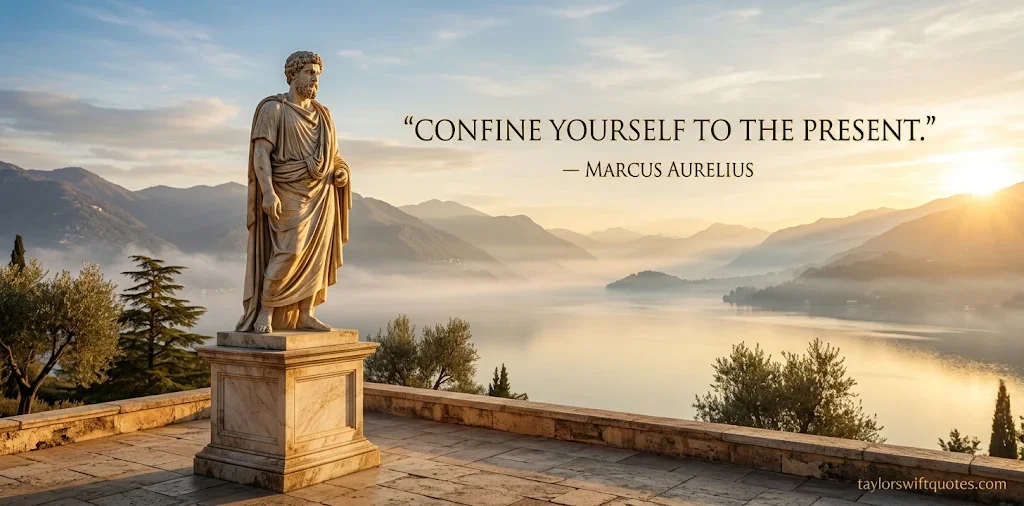
Marcus Aurelius: “Confine yourself to the present.”
Meaning: This short line sits in Meditations 7.29. Worry lives in “what if.” The present moment rarely holds the thing you fear. Seneca agreed that life feels short and anxious when we neglect the present.
Use it when: the Sunday scaries arrive or you are doomscrolling at midnight.
Try this: Take one slow breath. Name five things you can see. Then take the next small step.
Marcus Aurelius: “The impediment to action advances action.”
Meaning: From Meditations 5.20. The obstacle becomes the path. Ryan Holiday made the idea famous in The Obstacle Is the Way. Overthinking often disguises itself as preparation.
Use it when: you face analysis paralysis, a hard email or a big decision.
Try this: Pick the smallest action. Do it within five minutes.
How to Use Stoic Quotes to Stop Overthinking Every Day
A quote only helps if you use it. Build a tiny daily system.
Morning: Pick one quote from the list. Write it on a sticky note. Tie it to a habit, like your first coffee.
In the moment: Use a three-step reset. Pause. Label the thought by saying, “I’m having the thought that…” Then say your quote and do its action.
Evening: Seneca reviewed his day each night, as he describes in On Anger. Ask two questions. What did I worry about that I couldn’t control? What did I handle well?
Avoid three common mistakes:
- Suppressing feelings. Stoicism means you feel the emotion, then test your judgment of it.
- Collecting quotes without practice. Epictetus warned that learning without training fades.
- Expecting overnight change. The Stoic goal of ataraxia, or calm, grows slowly.
If overthinking blocks your sleep, work or relationships, talk with a licensed professional. CBT is well studied for this. In a crisis in the US, call or text 988.
FAQs
What is the best Stoic quote?
There is no single best one. For overthinking, Seneca’s line about imagination and reality is a top pick. It targets the root problem: fear of things that have not happened. Choose the quote that matches your worry today.
What are the 7 pillars of Stoicism?
The ancient texts give no official list of seven. Modern writers often name these: the dichotomy of control, virtue, living in agreement with nature, acceptance, present-moment focus, negative visualization (premeditatio malorum) and memento mori. Lists vary by author.
What is the best wisdom quote?
It depends on your need. A popular pick is Epictetus’s “Don’t explain your philosophy. Embody it.” It reminds you that wisdom shows up in daily actions, not in thinking alone.
What are the Stoic 4 rules?
They are the four cardinal virtues: wisdom, courage, justice and temperance. Wisdom helps you judge clearly. Courage helps you act. Justice keeps you fair instead of replaying grudges. Temperance stops you from feeding every worry.
Conclusion
The core idea is simple. Control your judgments and release the rest. These 7 Stoic quotes to stop overthinking give you a clear way to do that.

Jimmy Faisal is a passionate writer and quote enthusiast at Quotes Blooms. He enjoys exploring the power of words and sharing meaningful quotes, inspiring thoughts, and heartfelt messages that connect with people from all walks of life.