
Anxiety is common, and it often shows up at the worst times: 3 a.m., Sunday night, or mid-scroll through bad news. About 19.1% of U.S. adults had an anxiety disorder in the past year, and 31.1% will have one at some point in life, according to the National Institute of Mental Health. You are not alone.
Stoic quotes for anxiety offer a simple fix for the overthinking mind. They say pain comes less from events and more from how we judge them. Below are real lines from Marcus Aurelius, Seneca, and Epictetus, each with its source and one small step you can try today.
Table of Contents
What Did the Stoics Say About Anxiety? Stoicism for Anxiety Explained
The Stoics said anxiety comes from our judgments and imagined futures, not from events themselves. Peace comes from focusing on what you control.
Stoicism began in Athens around 300 BCE with Zeno of Citium. Its best-known voices came later: Seneca, a Roman statesman; Epictetus, who was born a slave; and Marcus Aurelius, a Roman emperor.
If your mind tends to replay the same worries on a loop, a short, focused set of Stoic quotes that stop overthinking can give you something simple to reach for the moment your thoughts start spiraling.
Three ideas matter most for anxiety relief:
- Dichotomy of control: some things are up to you (your choices, your effort). Others are not (other people, outcomes).
- Judgment: an event is neutral until your mind labels it a disaster.
- Premeditatio malorum: calmly picturing what could go wrong so you can prepare. This is different from catastrophizing, which is picturing it over and over with no plan.
Modern therapy borrowed from this. Psychologists Albert Ellis and Aaron Beck, who helped build cognitive behavioral therapy (CBT), both credited Stoic thinking, especially Epictetus.
| Anxious thought | Stoic reframe |
|---|---|
| “Everything will go wrong.” | “I’ll handle it with the same mind I have now.” |
| “This ruined my day.” | “What story am I adding to this?” |
| “I can’t control this.” | “What part of this is mine to act on?” |
Powerful Stoic Quotes for Anxiety From Marcus Aurelius, Seneca, and Epictetus

These lines come from public-domain translations, so you can check every one. Each has a plain meaning and a quick practice.
Marcus Aurelius, Meditations 9.13
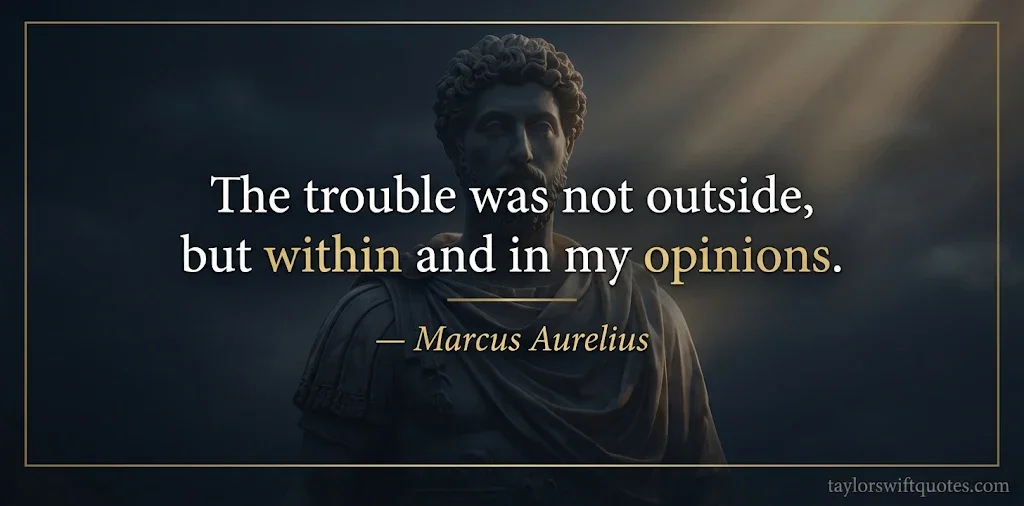
“To-day I have got out of all trouble, or rather I have cast out all trouble, for it was not outside, but within and in my opinions.”
Meaning: The trouble was in his thinking, so he could drop it. Try this: When worry rises, say, “This is a thought, not a fact.”
Marcus Aurelius, Meditations 8.47
“If thou art pained by any external thing, it is not this thing that disturbs thee, but thy own judgment about it. And it is in thy power to wipe out this judgment now.”
Meaning: Your reaction is a choice you can revise. Try this: Write one anxious thought, then cross out the story you added.
Marcus Aurelius, Meditations 7.8
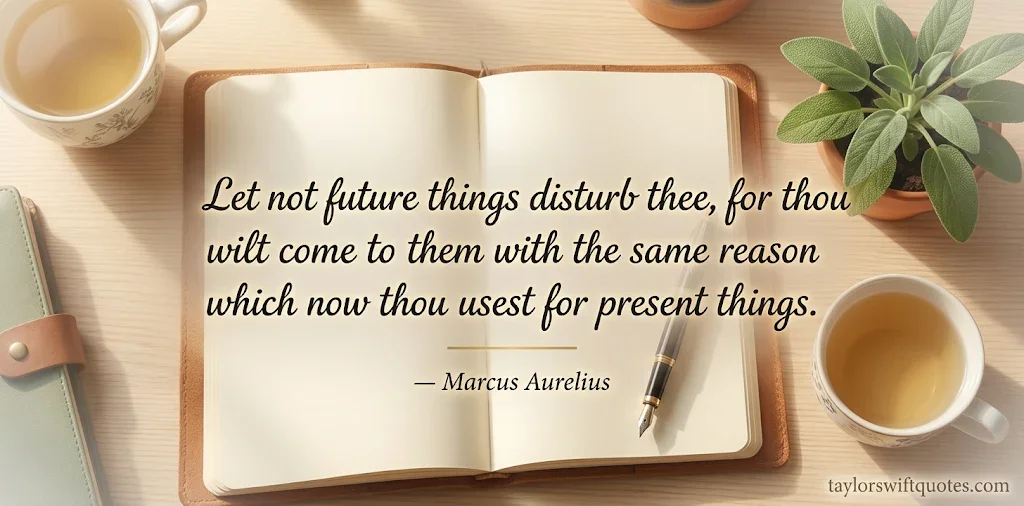
“Let not future things disturb thee, for thou wilt come to them, if it shall be necessary, having with thee the same reason which now thou usest for present things.”
Meaning: Future you will have the same brain and skills. Try this: Tell yourself, “I’ll meet it with the mind I have now.”
Marcus Aurelius, Meditations 4.3
“Nowhere either with more quiet or more freedom from trouble does a man retire than into his own soul.”
Meaning: Calm is a place you can return to. Try this: Close your eyes for one minute and breathe slowly.
Seneca, Letter 13, On Groundless Fears
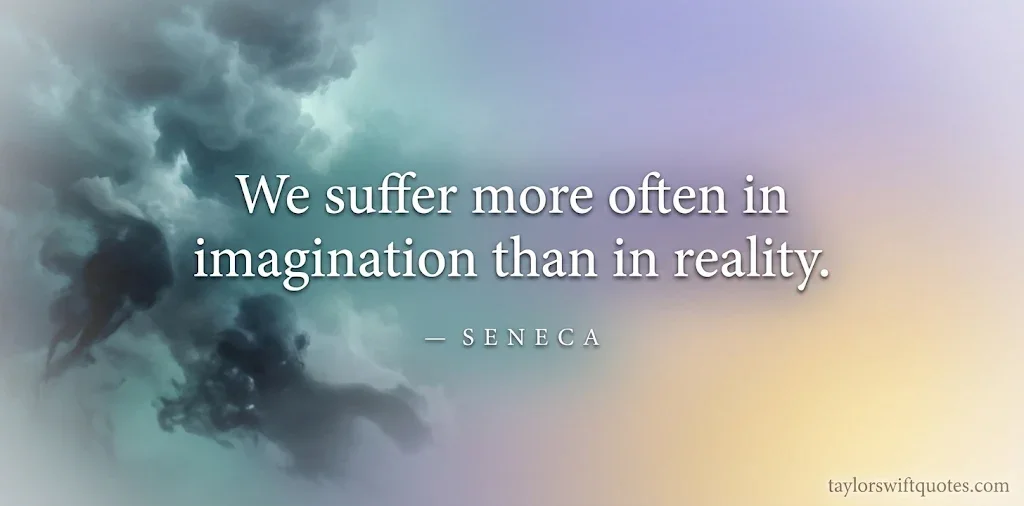
“We suffer more often in imagination than in reality.”
Meaning: Most dreaded events never arrive in the form we picture. Try this: Ask, “Is this happening now, or only in my head?”
Seneca, Letter 101
“For he only is anxious about the future, to whom the present is unprofitable.”
Meaning: Wasted time today feeds worry about tomorrow. Try this: Pick one useful task and finish it.
Epictetus, Enchiridion 5
“Men are disturbed not by things, but by the views which they take of things.”
Meaning: Your view of an event shapes your stress. Try this: Describe the event in one neutral sentence, with no opinions.
Epictetus, Enchiridion 1
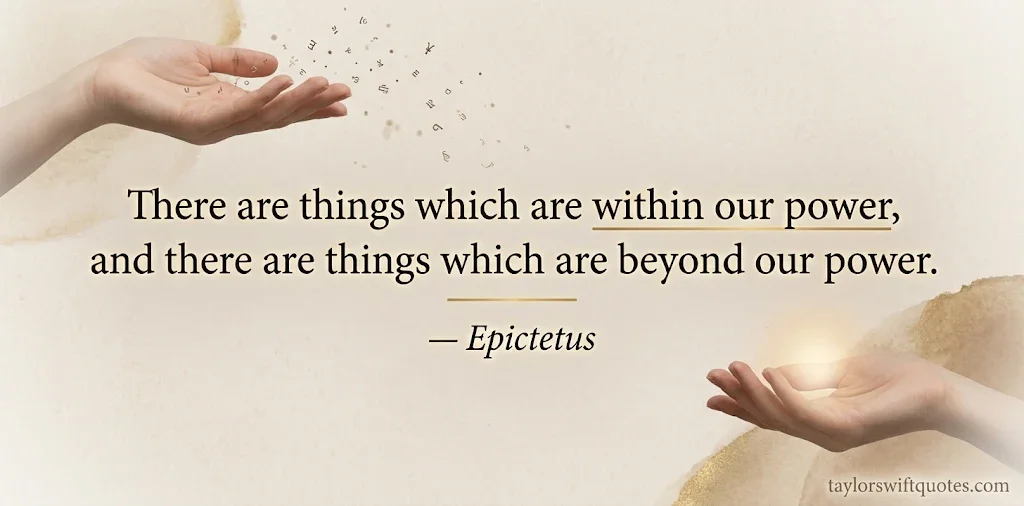
“There are things which are within our power, and there are things which are beyond our power.”
Meaning: Spend effort only where it counts. Try this: Make two lists, “mine” and “not mine,” and act on the first.
Stoic Quotes About Fear: Stop Overthinking and Find Inner Peace
Fear often sits under daily worry: fear of loss, failure, or judgment. The Stoics met it head-on instead of running from it.
Seneca, Letter 18, advises practicing small hardships on purpose. Live on simple food and rough clothes for a few days, then ask, “Is this the condition that I feared?” Most people find it is bearable. That discovery shrinks the fear.
Marcus Aurelius, Meditations 10.29, asks whether we fear death only because it ends our busy habits. When you face the biggest fear, smaller ones lose weight.
Modern triggers respond to the same tools:
- News overload: Check headlines once or twice a day. Ask, “Can I act on this?”
- Money stress: List what you can change this week, such as one bill or one budget line.
- Social comparison: Remember that you control your effort, not other people’s highlights.
- Fear of failure: Picture the worst case, plan one step to handle it, then return to work.
Two Stoic habits help here. Amor fati means accepting what happens and working with it. The discipline of assent means you don’t have to agree with every scary thought.
A tip for busy professionals: set a 10-minute “worry window” for tomorrow’s problems. Write down solutions, then stop and go back to today.
How to Use Stoic Quotes to Calm Anxiety Every Day
A quote works best when it becomes a habit. This takes about five minutes.
- Name it. Write your worry in one sentence.
- Sort it. Make a “within my control” list and a “not within my control” list.
- Read it. Choose one matching quote and read it slowly.
- Act. Do one small thing from the first list.
- Review. At night, ask, “What did I judge today that I didn’t need to?”
Try these Stoic journaling prompts too. In the morning: “What might upset me today, and how will I respond?” In the evening: “Where did I act with calm, and where didn’t I?”
When to get help: If anxiety lasts for months, spreads into many areas of life, or keeps getting worse, talk to a licensed professional. NIMH explains how to find help. If you are in crisis in the U.S., call or text 988 to reach the 988 Suicide & Crisis Lifeline.
FAQs
What did the Stoics say about anxiety?
They taught that anxiety comes from our opinions and imagined futures, not from events. Focus on what you control, accept what you don’t, and keep your attention on the present.
What is a powerful quote about anxiety?
Seneca’s line is a strong pick: “We suffer more often in imagination than in reality.” It comes from Letter 13 to Lucilius and reminds us that many feared events never happen.
What did Marcus Aurelius say about anxiety?
In Meditations 9.13, he wrote that his trouble was “not outside, but within and in my opinions.” In 8.47, he said pain from outside things comes from our judgment, which we can wipe out.
What did Einstein say about anxiety?
Einstein was a physicist, not a Stoic, and I found no well-sourced quote from him about anxiety. Many “Einstein quotes” online lack a real source, so check for a book, speech, or letter before sharing one. The Stoic lines above are all traceable to their texts.

Jimmy Faisal is a passionate writer and quote enthusiast at Quotes Blooms. He enjoys exploring the power of words and sharing meaningful quotes, inspiring thoughts, and heartfelt messages that connect with people from all walks of life.